Message Sent
Thank you for your inquiry. We will respond to you as soon as possible.


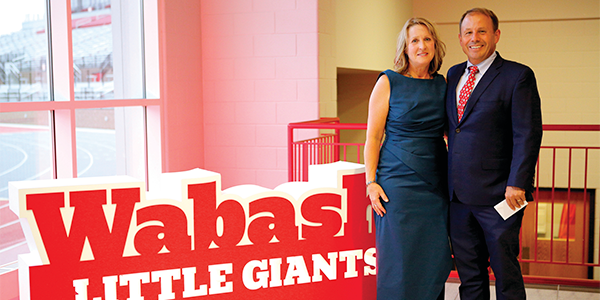
As Scott was quick to point out, "It's not as much about the current roles Wendy and I have here as it is our 28 years of sustained relationship with the College."
The Fellers came to Crawfordsville in July 1998 from Washington, where Scott was teaching chemistry at Whitman College. Scott became the Lloyd B. Howell Professor of Chemistry at Wabash, then Dean of the College from 2014-20, and then the 17th President elected by unanimous vote of the Board of Trustees in 2020. He's the first Wabash President to rise from the ranks of the faculty and administration since Byron K. Trippet in 1956.
The Fellers' long relationship with the College also includes their ties to the land of Montgomery County. Since 2001, they've owned and run Silver Valley Farm northwest of Crawfordsville, where they raise sheep.
"You'll notice there's no silver in the Wabash Valley," Scott joked. The name is a portmanteau of each of their family's farms in Oregon: Scott's family owned a property called Silver Creek Farm, and Wendy's family-owned Evans Valley Farm.
Wendy explained, "My parents farmed just three miles outside of town, raising cattle, hay, and grass seed. I spent summers helping with harvest, driving tractor or combine mostly. Scott's family had a sheep farm like our own farm on the edge of Silverton and they lived in town. They raised sheep and showed them in 4-H and at the Oregon State Fair. These farms were about four miles from each other just outside of Silverton, Oregon, where we grew up. Scott's dad was our dentist."
With Silver Valley Farm, the Fellers returned to their farming roots while raising their two children. Now that their kids are grown, Wendy has started a small business selling lamb, hand-dyed yarn, and handmade soaps.
Recently, Wendy and her four siblings inherited land from her paternal grandmother. "I'm the youngest," Wendy said. "My brother has been farming this piece of land for many years, so he was interested in purchasing it from us."
The Fellers instantly knew that this asset could benefit the College. "The sale of land makes sense," Scott said. "It's not something we're not going to go home to. If there was a way for us to meld our love for Wabash and send that money to the College, that was super attractive to us."
After consulting with David Troutman, the College's Director of Gift Planning, the Fellers explored a range of charitable planning options. With his guidance, they ultimately chose to establish a specialized form of charitable remainder unitrust (CRUT) known as a FLIP-CRUT. This approach is well suited for highly appreciated real estate that generates little or no current income and would otherwise trigger significant capital gains tax if sold outright.
Through tailored structuring, the trust was designed to provide minimal-if any-income during its early years, allowing the Fellers to support the work of the College, while also receiving an initial partial charitable income tax deduction at the time the trust was established. Upon the Fellers' eventual retirement, the trust will "flip" from a net-income-only arrangement to a standard unitrust payout, aligning a higher income stream with the conclusion of full-time employment.
"For many people, a charitable remainder trust is the intersection of tax planning, retirement planning, and philanthropy," Scott observed. "In our minds, those elements are closely intertwined-but the philanthropic component was a significant driver for us. The philanthropy part isn't really that different from the Annual Fund contributions we've been making through the years."
As President, Scott became more aware of specific mechanisms for philanthropy to the College. Similarly, Wendy's work with the newly established Wabash Women's Collective has given her a different lens to view philanthropy with the College.
Sitting with David, they explained "He took us from concept to know-how," Scott said. "I probably made four more visits to David's office asking follow up questions. He patiently walked us through the options and answered our questions to customize the details of a trust in the way that works for our specific situation.
"We have pretty high-level of trust in the College," Scott continued. "Ultimately, the charitable remainder trust is going to be part of our legacy gift to Wabash College, so we'll see how it fits together with other things we ultimately decide to do. This gives you some time and some flexibility to assess both so you don't feel pressured to work out the details of the structure of the charitable remainder trust from what is ultimately going to do for Wabash."